Hypebeast
“Running from the 10th to the 13th of June, Other Circle bills itself as “post-disciplinary creative culture” – a gathering point for design, art, fashion, food and music that resists easy categorisation.”
“A new addition to the Copenhagen design scene, Other Circle made waves last year as probably the most high-profile show outside the official 3 Days of Design schedule.”
Watch reel at @emcho41
Souvenir gathers artists and designers working across distinct materials and modes of making, each rethinking the vessel as object, memory, and trace. Co-curated by Alex Tieghi-Walker of TIWA Select and Felix Burrichter of PIN–UP, and co-presented by Other Circle
Watch reel @pinupmagazine
“One of the highlights is a partnership between LA-based design studio PlayLab and Designmuseum Denmark, reinterpreting design classics from the museum’s collection.”
“It’s an eclectic line up that’s sure to delight”
“There is no doubt this inter-cultural, programmed type of show is the way forward, bringing engagement and life to the dusty old design exhibitions of yore.”
“The World’s best restaurants, Asics sneakers & ultra rare books… all under one roof”
“This international design exhibition from the production team behind production house The Lab Copenhagen blurred the boundaries between form and function with idiosyncratic objects, such as Marianne Skarbøvik’s Chained Candelabra and Kristine Five Melvær’s found ceramic vessels covered in Norwegian textiles.”
“It would be an exaggeration to call the rollout of Other Circle a controversy. But it speaks to the fundamental challenge of keeping a festival like 3 Days in the Goldilocks zone. One of its defining—and maybe best—features is the absence of a big, old-school convention hall. But without deciding who can rent booths, 3 Days can only exert so much control over who shows up and how. This year, it may be newcomers with a different philosophy about interdisciplinary boundaries.”
“The group exhibition “other circle” held an exhibition during the same period and attracted attention. It is a platform that questions the meaning of distinguishing between the fields of architecture, furniture, art, food, and music, and showcases the work of creators who are seamlessly influenced by a variety of fields in an era without boundaries.”
“Other Circle. This group show, which pairs emerging talents with established names, brings together fifty exhibitors in a single space. These include the Italians NM3, the Danish company Muuto, as well as A Kassen, Atelier September, cc-tapis + Rop van Mierlo, Emma Clarke, Forma, Adorno, House of Bolon, Pedestal, and many others.”
“More so than previous years, there seemed to be a strong independent spirit, with non-branded group shows feeling to have more of a presence across the city. It used to be that you’d leave 3DD feeling as though you’d completed it, but not anymore. And that’s not a bad thing, as this year, it left us wanting more.”
“The invite-only exhibition (free for exhibitors) brought together a diverse range of participants, from globally renowned names such as Gaetano Pesce (presented by Meritalia) and Noma Projects, to brands like Jotun and emerging studios such as Niko June and Joy Objects, the latter drawing a particularly strong reception. Held at The Lab, just outside the city centre, the event still managed to attract a dedicated audience, helped along by Copenhagen staples such as the Pompette wine bar and a lively evening program of parties.”
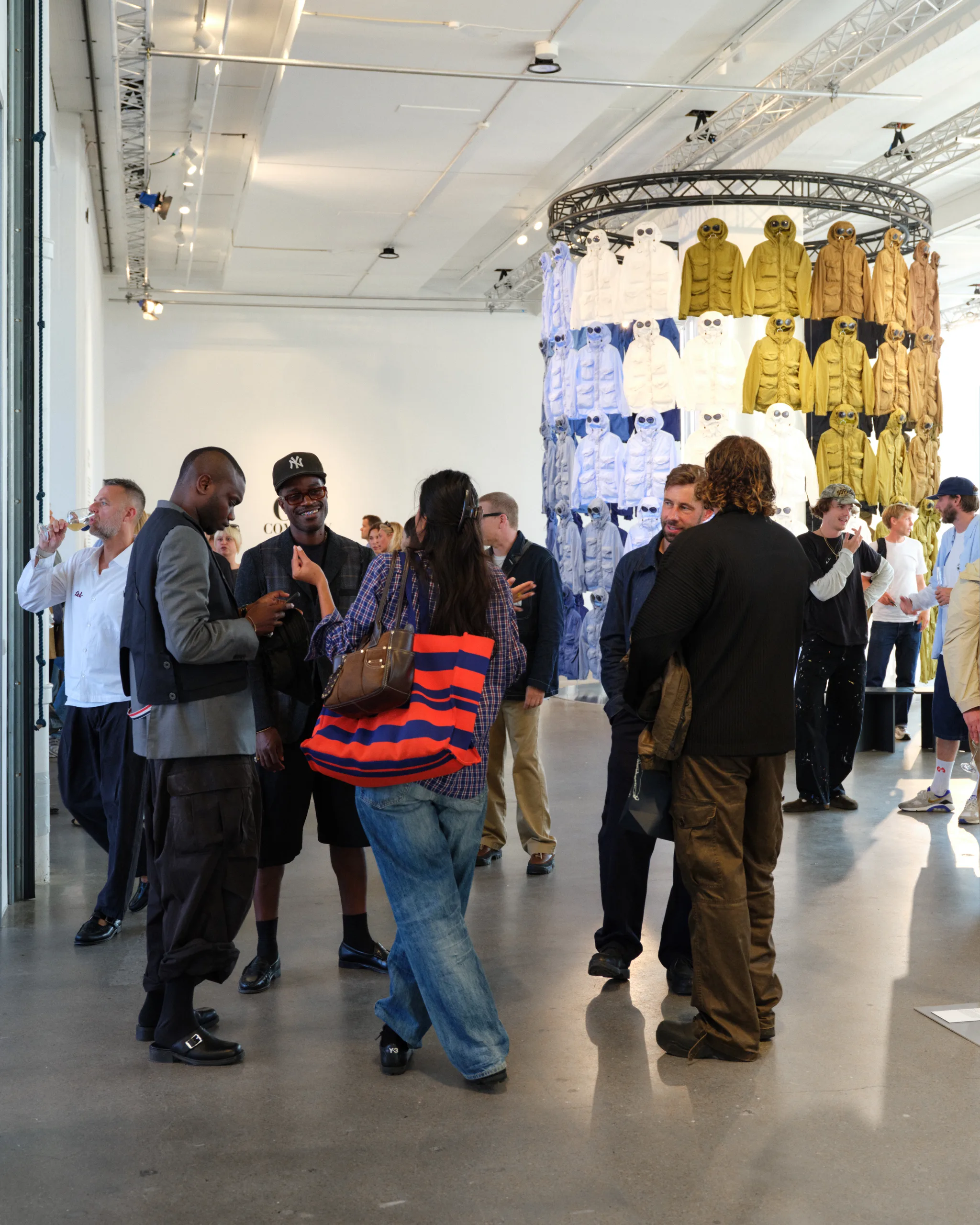
“And then there was Other Circle. Conceived as Copenhagen’s answer to shows like Alcova and Capsule Plaza, and operated independently from 3daysofdesign, the newly launched exhibition felt like a revelation. Hosted at The Lab, a photography studio just outside the city centre, the multidisciplinary show gathered participants from design, art, music, fashion and food to create a platform for exchange and dialogue. There was a certain kind of magic here, one of genuine presence. Instead of being glued to their phones, people engaged with each other.”
Conversation with Max Lamb and Felix Burrichter
Max Lamb’s practice resists the usual divisions between design, research, making, and lived experience. Whether working with stone, cardboard, recycled materials, tiles, furniture systems, or the fabric of his own home and studio, Lamb approaches design as a process of testing: how things are made, how they are used, how they age, and how they gather meaning over time.
On the occasion of his collaboration with Wasted by Potato Head at other circle, this conversation between Lamb and Felix Burrichter looks at his work as an expanding inventory — shaped by material exploration, workshops, commercial projects, self-initiated research, the ongoing renovation of his London studio, and the occasional risk of bodily harm.
Live conversation: Wednesday 10th of June, 2:00 – 3.00 PM
The Post-Disciplinary Connector
Every act of powerful creative work runs on something no single discipline can name. Before it is a dish, a building or a piece of music, it is energy, a charge that holds the power to shape the shapeless, to summon something into being. Curating Energy asks how we generate, sustain and protect that force, especially across a post-disciplinary creative process: inside teams, between collaborators, in a social context, and in our relationship to ourselves. At a moment when “energy” has been captured by power grids, data centers or informational chaos, this panel asks how we can reclaim the concept for the creative field, and how we make it actionnable.
Live Panel Talk: Wednesday 10th of June, 3:30 – 5.00 PM
Charging and changing the world around
“We don’t serve food – we serve energy” – Kenneth Foong, Fermentation Director, NOMA (Other Circle 2025)
When a work of art or a design objects truly hits its mark, something happens. Something is transmitted, irreducible to its support or its medium. How do we name and describe this energy that travels from the creator to the public? And how do we keep it alive along the chain of logistics, through the accidents and the unforeseen? Whether we call it an aura, a presence, an effect, a mood, even a « vibe », every creation sets out to change the world and the energy of the one it reaches, and often to let itself be changed by theirs. Serving Energy explores the sites and the implications of what is simultaneously a transmission and an exchange.
Live Panel Talk: Thursday 11th of June, 3:30 – 5.00 PM
Beyond Scandinavian Functionalism
The Northern European design tradition carries a double legacy. The mid-twentieth-century Scandinavian pioneers – Wegner, Børge Mogensen, Poul Kjærholm, Arne Jacobsen – drove a genuine revolution: beautiful, functional objects made available to the many. That project changed what design thought it was for. But what was radical is now conventional. The aesthetic vocabulary of that era has become the default register of good taste – its forms reproduced endlessly, its prices rising, its original democratic ambition quietly forgotten. Meanwhile, the Nordic societies that produced it have become genuinely multicultural, and the global flow of images and ideas through social media and the internet has made non-Eurocentric design traditions more visible and more influential than at any previous moment.
This panel asks how the design world responds to that shift – not by abandoning a tradition, but by genuinely expanding it. What does respectful cross-cultural influence look like in practice? And what is the difference between exchange and extraction?
Live Panel Talk: Friday 12th of June, 1:00 – 2:00 PM
The Present and future of creative tools
A brush never had an opinion about what you should paint. Every tool we’ve ever made (the camera, the typewriter, the synthesizer…) waited for us to move first. The tools we now hand to artists, designers, architects and writers are different in kind: often anthropomorphic, trained on the collective work of everyone, they arrive with their own biases, and they propose, they generate, they act… So the question is no longer whether to use them, but how; how do we take what they offer without losing ourselves, mistaking their fluency for our own voice? Beneath how do we stay creative lurks another deeper more fundamental question: how do we stay human? The Human Circle panel is set to understand the new ways to unleash our creativity and the challenges that come with them.
Live Panel Talk: Friday 12th of June, 3:30 – 5:00 PM
Conversation with Caspar Eric and Anne Dorthe Vester
Design has always claimed to be about people. But the built environment – the spaces, objects and systems that constitute daily life – has been shaped overwhelmingly around a narrow model of the human body and mind. How does this affect our inner and outer landscapes. And can we envision a different way of placing a body in a chair.
Live conversation: Saturday 13th of June, 12:00 – 1:00 PM